Your organization doesn’t need a better plan
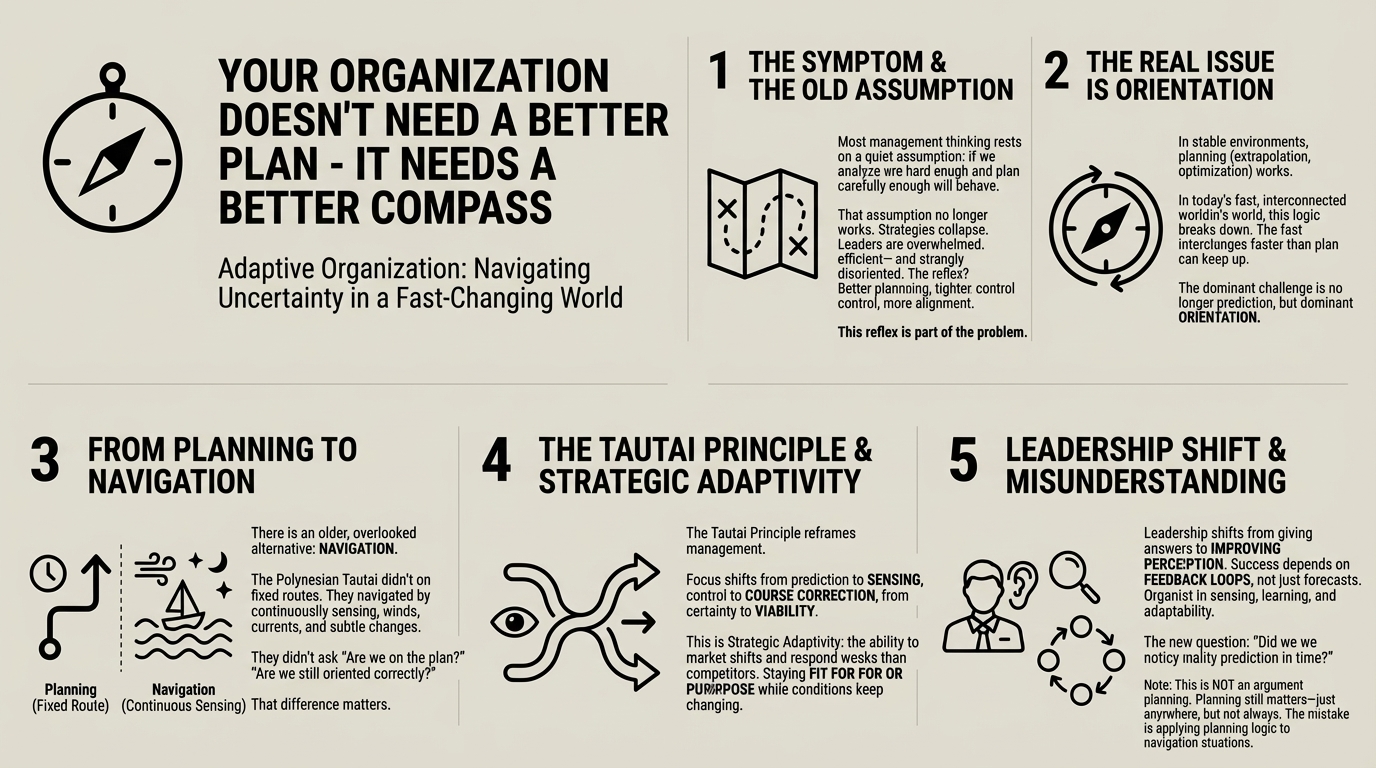
::u-button
class: py-1 [&_p]:my-0 size: md to: /skills/w01-your-organization-doesn-t-need-a-better-plan.skill download: w01-your-organization-doesn-t-need-a-better-plan.skill external: true
Download the Skill ::
Sensemaking & Viability Framing:brTarget audience: Advanced consultants
Purpose of this skill
This first skill establishes the foundation for all subsequent work in the Tautai approach: sensemaking before intervention.
For advanced consultants, the core challenge is rarely a lack of tools or methods. The challenge is entering complex client systems without prematurely collapsing ambiguity into solutions, diagnoses, or frameworks. This skill trains the ability to frame organizational situations in terms of viability rather than performance, maturity, or execution quality.
The skill is especially relevant for consultants working with:
- senior leadership teams under high uncertainty
- organizations experiencing “permanent change” fatigue
- clients where agile, OKRs, or classic change approaches have plateaued
The aim is to shift your consulting stance from problem-solving to problem-seeing — and to help clients do the same.
What this skill enables
After mastering this skill, you should be able to:
- distinguish viability problems from execution or alignment problems
- recognize early management traps (planning, alignment, hero leadership)
- articulate why an organization feels stuck without blaming people or culture
- hold ambiguity long enough to allow better system-level insight to emerge
This is a meta-skill: it governs when and how all other consulting skills are applied.
How to use this skill (practical instructions)
1. Use it at the very beginning
Apply this skill before proposing:
- diagnoses
- frameworks
- roadmaps
- interventions
Your primary output at this stage is clarity, not solutions.
2. Frame conversations around viability
In client conversations, deliberately replace questions like:
- “What isn’t working?”
- “What should be changed?”
with:
- “What makes this organization viable today?”
- “What has changed faster than the organization?”
- “Where does the current operating model no longer fit?”
3. Slow down premature certainty
When clients jump quickly to solutions:
- name the jump explicitly
- invite reflection on underlying assumptions
- redirect attention to weak signals and tensions
This is not resistance — it is professional discipline.
4. Document insights, not actions
At the end of Week 1, your artifacts should be:
- a shared viability framing
- a small set of unresolved core tensions
- explicit assumptions worth testing
Avoid action plans. If actions appear, treat them as hypotheses, not commitments.
Consultant stance to practice
- Curious, not corrective
- System-focused, not role-focused
- Comfortable with not-knowing
- Precise in language, modest in claims
If Week 1 feels “unproductive” to action-oriented clients, you are likely doing it right.
Outcome of Week 1
A successful Week 1 does not end with agreement on what to do.
It ends with agreement on:
What the organization is really dealing with.
Everything else builds on that.